
Many small business owners in Singapore see bookkeeping as a chore that they only have to do when tax season comes around or when their bank balance is hard to understand [1]. But this way of doing things costs you money [2].
Keeping your books in order every month isn’t just about following the rules; it’s also one of the best ways to save money on taxes, manage cash flow, and grow your business [3]. When your books are correct and up to date, you can see how your finances are doing, take every legal deduction, and sleep better knowing that you are meeting your obligations.
This guide goes over the best ways for Singaporean small and medium-sized businesses (SMEs) to keep their books up to date each month. It also includes a useful flow that you can start using right away.
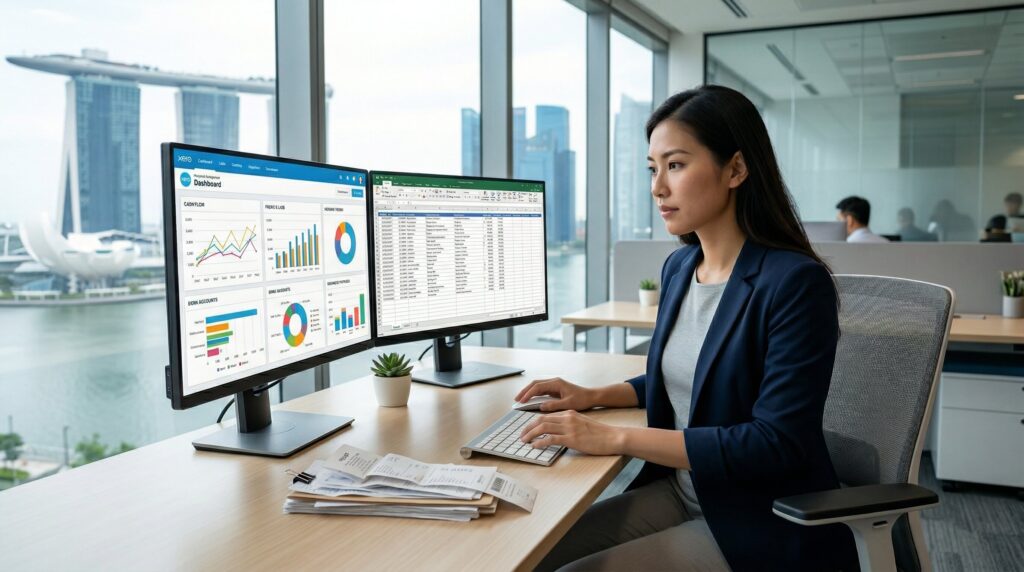
The Real Price of Not Keeping Your Books
Before we get into best practices, let’s talk about how much bad bookkeeping really costs [2], [4]:
| Cost that isn’t obvious | Impact |
| Tax deductions that were missed | If you don’t keep track of your expenses, you can’t claim deductions, and you’ll have to pay more taxes. |
| Surprises in cash flow | You can’t predict shortfalls if you can’t see them. |
| Late penalty fees | IRAS fines apply when you miss filing deadlines. |
| Stress from the audit | When records are not organized, IRAS queries are too much to handle. |
| Poor choices in business | You can’t plan if you don’t have accurate data. |
A few hours a month will stop these headaches and put money back in your pocket [3].
A Step-by-Step Guide to Monthly Bookkeeping Flow
Staying the same is important. This is the best way for small and medium-sized businesses in Singapore to keep their books each month [5]:
Week 1: Check and Balance
- Checking the bank statement: Get bank statements for all of your accounts. Check every transaction against your records. Look into differences right away. Mark items that haven’t been cleared for follow-up.
- Checking Your Credit Card: Look over all of your business credit card statements. Make sure that personal expenses are kept separate and recorded correctly. Make sure you have receipts for all of your purchases.
- Count the petty cash: Count the cash you have on hand in person. Check against petty cash receipts. Add more as needed.
Week 2: Writing down the steps
- Processing Invoices: Make sure all sales invoices are sent and raised. Check that tax invoices from suppliers are complete and correct. Scan and save all of your receipts (digital is best).
- Follow up on accounts receivable: Look over the report on old receivables. Get in touch with customers who haven’t paid yet. Change the status of the payment.
- Review of Accounts Payable: Set up payments for the future. Use early payment discounts. Check the statements from your suppliers against your own records.
Week 3: Reporting and Looking at the Data
- Make reports for management: Statement of Profit and Loss, Balance Sheet, Statement of Cash Flow, Comparison of budget and actual.
- Look over the important numbers: The gross profit margin, ratio of operating costs, ratio of current, days sales outstanding.
Week 4: Get Ready for Next Month
- Getting ready for GST (if necessary): Check that input tax claims are valid. Make F5 working papers. Bring up any problems that need to be fixed before the filing deadline.
- Sort and file: Keep digital copies of all your documents in a safe place. Make changes to your system for keeping documents. Write down notes for your accountant to use when they take over.
Chart of Accounts Example for Small and Medium-Sized Businesses in Singapore
A well-organized chart of accounts (COA) makes it easy to keep track of your finances and make sense of your reports [6]. Here’s a simplified example made just for businesses in Singapore:
| Account Code | Account Name | Type | Description |
| Assets | |||
| 1000 | Bank – OCBC Current | Current Asset | Operating account |
| 1100 | Accounts Receivable | Current Asset | Customer amounts owed |
| 1200 | Prepaid Expenses | Current Asset | Insurance and rent paid in advance |
| 1300 | Fixed Assets | Fixed Asset | Computers, furniture, and equipment |
| 1310 | Accumulated Depreciation | Contra Asset | Less: accumulated depreciation |
| Liabilities | |||
| 2000 | Accounts Payable | Current Liability | Supplier amounts owed |
| 2100 | GST Payable | Current Liability | GST collected from customers |
| 2200 | GST Input Recoverable | Current Asset | GST paid to suppliers |
| 2300 | Accrued Expenses | Current Liability | Unpaid bills |
| 2400 | Loans Payable | Long-Term Liability | Bank loans and director loans |
| Equity | |||
| 3000 | Share Capital | Equity | Owner investment |
| 3100 | Retained Earnings | Equity | Accumulated profits |
| 3200 | Current Year Earnings | Equity | This year’s profit or loss |
| Revenue | |||
| 4000 | Sales – Products | Revenue | Product income |
| 4100 | Sales – Services | Revenue | Service revenue |
| 4200 | Other Income | Revenue | Interest, other things |
| Cost of Goods Sold | |||
| 5000 | COGS | Cost of Goods Sold | Direct product costs |
| 5100 | Freight In | COGS | Shipping costs on purchases |
| Expenses | |||
| 6000 | Salaries and Wages | Expense | Employee pay |
| 6100 | CPF Contributions | Expense | Employer CPF |
| 6200 | Rent Expense | Expense | Office rent |
| 6300 | Utilities Expense | Expense | Electricity, water, internet |
| 6400 | Professional Fees | Expense | Accounting, legal, consulting |
| 6500 | Office Supplies | Expense | Stationery, consumables |
| 6600 | Travel and Entertainment | Expense | Client meals and travel |
| 6700 | Repairs and Maintenance | Expense | Equipment repairs |
| 6800 | Insurance Expense | Expense | Business insurance |
| 6900 | Bank Charges | Expense | Transaction fees |
| 7000 | Depreciation Expense | Expense | Asset depreciation |
| 7100 | Miscellaneous Expense | Expense | Small unclassified expenses |
Tip: Make this COA fit your business. Different industries will naturally have slight differences based on their specific operations and needs [6].
A Sample Bookkeeping SOP for Small and Medium-Sized Businesses in Singapore
Standard Operating Procedures make sure that things stay the same, even when staff changes [7]. Here’s an example of a SOP for keeping track of your books every month:
SOP-001: Monthly Bank Reconciliation
- Goal: Make sure that all bank transactions are recorded correctly and balanced.
- Responsible: Bookkeeper / Accountant
- Frequency: Every month, by the 7th business day
- Steps:
- Sign in to your online banking account and download your business account statements in PDF or CSV format.
- Import statements into accounting software like Xero, QuickBooks, etc.
- For each bank transaction, find a matching entry in the system.
- Make new entries for items that don’t match with the right code.
- Look into and fix any differences that are more than $50.
- Check the accuracy of the reconciliation report.
- Mark transactions that are out of the ordinary for management to look at.
- Lock the time period after the reconciliation is done.
- Needed Documents: Statements from all of your bank accounts, report on the reconciliation from last month, list of checks that haven’t been presented, deposit slips (if needed).
- Required Review By: Partner / Financial Controller
SOP-002: Review of Accounts Receivable Ageing
- Purpose: Keep an eye on customer payments and find problems with collections.
- Responsible: Bookkeeper or Accounts Executive
- Frequency: Once a week
- Steps:
- Make a report on aged receivables as of the end of the week.
- Show amounts that are more than 30 days late.
- Look at the last week to see if there are any trends.
- Make a list of customers who haven’t paid their bills yet for management.
- Make sure to write down the current status of each customer’s collection.
- Send monthly statements of account to customers who are behind on their payments.
- Escalation:
- 30 days: Email reminder
- 60 days: A phone call and a letter in the mail
- 90 days: Management review for legal action or provision
How Keeping Your Books Right Can Save You Money on Taxes
This is where good record-keeping pays off [2], [3], [8]:
1. Don’t forget about deductible expenses
You can deduct every business expense you keep track of from your taxes. Some common deductions that people forget to take are:
- Costs that happened before the business started (pre-operating expenses)
- Small purchases of assets (fully deductible if they cost less than $1,000)
- Classes for training at work
- Part of your home expenses that are for business (if you work from home)
- Interest on loans for businesses
- Subscriptions and memberships for professionals
2. Get the most out of your capital allowances
Tracking your computers, furniture, and machinery properly makes sure you get the right capital allowances (depreciation) every year [9].
3. Prove Your Claims During Audits
It’s less stressful to have an IRAS audit when you have a receipt for every expense and a clear business reason for it in your books [8].
4. Correct GST Input Tax Claims
If you don’t have the right tax invoices, you can’t make a claim. You can get every dollar of input tax you’re owed by doing a proper monthly reconciliation [10].
5. Stay out of trouble
Penalties are given for filing late or incorrectly. Keeping your books up to date means you’re always ready for deadlines [4].
Why Monthly Bookkeeping Is Important: Benefits Beyond Taxes
- Better management of cash flow: When you reconcile every month, you can see cash flow problems before they get out of hand. You know exactly when payments are due, when customers are late, and how much time you really have [1].
- Filing taxes faster: Instead of a month-long scramble, filing your taxes at the end of the year takes only 30 minutes. You save money on professional fees and your accountant thanks you [3].
- Smart Business Choices: Should you hire that new employee? Do you have enough money to buy new tools? You can trust your choices when you have accurate monthly numbers [2].
- Easier to Get Money: Investors and banks want to see your current financial statements. Well-kept books make it easier to get loans and get better terms [5].
- Peace of Mind: You can’t beat knowing that your finances are in order. You won’t have to stay up all night wondering if you forgot something.
Cloud Accounting: A Big Deal for Small Businesses
Modern cloud accounting software turns bookkeeping from a chore into a useful tool [11].
The Pros of Cloud Accounting
- Visibility in real time: You can see your money at any time and from any place.
- Bank feeds—transactions are automatically imported.
- Scanning receipts—Upload receipts using a mobile app.
- Automated reconciliation: AI compares transactions.
- Secure backup means you won’t lose any paper records again.
- Accountant access: Your advisor can see real-time data.
Common Choices in Singapore [11]
- Xero is easy to use and great for service businesses.
- QuickBooks Online has strong inventory features.
- AutoCount is popular with small and medium-sized businesses and has strong local support.
Most accounting firms, like PC Lee & Co., offer cloud accounting support. We can set up your system, train your staff, and keep an eye on things from a distance [12].
When to Outsource and When to Do It Yourself
| Factor | In-House | Outsource |
| Cost | Salary, benefits, training | Fixed monthly fee |
| Knowledge | Only staff skills are allowed | Access to trained experts |
| Ability to grow | Must hire more people as you grow | Grows with your business |
| Continuity | Staff leaving causes problems | Always covered |
| Technology | You pay for the software | Part of the service |
| Supervision | You take care of | Professional reviews |
For most small and medium-sized businesses, hiring a trusted company like PC Lee & Co to do their monthly bookkeeping is cheaper and better than hiring in-house staff [12].
Your List of Things to Do for Monthly Bookkeeping
To stay on track, use this easy list [5], [7]:
☑️ Accounts at the bank were balanced
☑️ Credit cards balanced
☑️ Counted and balanced petty cash
☑️ All invoices from suppliers have been entered and coded
☑️ All invoices for sales were made and sent
☑️ Receipts scanned and added to transactions
☑️ Accounts receivable were looked at and followed up on
☑️ Scheduled accounts payable
☑️ GST working papers made (if necessary)
☑️ Reports made by management and looked over
☑️ Backed up digital files
☑️ Projected cash flow for next month
We’ll Take Care of Your Monthly Bookkeeping
Good bookkeeping is the key to financial success. But it takes a lot of time and attention to detail, which is time you could be using to grow your business [3].
At PC Lee & Co, we focus on providing monthly bookkeeping services to small and medium-sized businesses in Singapore. Our team makes sure that your books are always correct, current, and ready for taxes. You get [12]:
- A professional bookkeeper who is dedicated
- Setting up and supporting cloud accounting
- Reports on finances every month
- Getting ready for GST
- Tips for saving on taxes
- Calmness
Book a consultation today to find out how our Singapore bookkeeping services can help your business grow, lower your stress, and save you money on taxes.
📞 Call us at 6737 3710
✉️ Email: enquiries@pc-lee.com
📍 Visit: 545 Orchard Road, #10-06 Far East Shopping Centre, Singapore 238882
References
[1] Singapore Business Federation (SBF). (2025).SME Financial Management Practices Survey.
[2] Inland Revenue Authority of Singapore (IRAS). (2025).Record Keeping Guide for Businesses.
[3] Accounting and Corporate Regulatory Authority (ACRA), Singapore. (2025).Guide to Financial Management for SMEs.
[4] IRAS. (2025).Late Filing and Late Payment Penalties.
[5] Association of Chartered Certified Accountants (ACCA). (2024).Best Practices in Monthly Bookkeeping.
[6] Institute of Singapore Chartered Accountants (ISCA). (2024).Chart of Accounts Standardisation for SMEs.
[7] International Organization for Standardization. (2022).ISO 9001:2015 – Documentation and Record Keeping.
[8] IRAS. (2025).Deductible Business Expenses – A Guide for SMEs.
[9] IRAS. (2025).Capital Allowances: A Guide to Claiming Depreciation.
[10] IRAS. (2025).GST Guide for Businesses – Input Tax Claims.
[11] Infocomm Media Development Authority (IMDA), Singapore. (2025).SMEs Go Digital: Cloud Accounting Solutions.[12] PC Lee & Co. (2025).Outsourced Bookkeeping and Accounting Services.